
June 15, 2026
If your practice film is shaky, too low, or missing key angles, the problem usually is not your coaching. It is your capture setup. A good football practice video guide starts with one basic truth: the value of practice film depends on whether coaches can actually use it the same day, without fighting the equipment.
For most football programs, practice video has to do three jobs at once. It has to help position coaches teach details, give coordinators a clean view of structure and spacing, and fit into the same replay or upload workflow your staff already uses. That means the best filming setup is not the one with the longest feature sheet. It is the one that gets on the field fast, stays stable in wind, and produces consistent footage every day.
A lot of advice on practice filming gets stuck on camera specs. Resolution matters, but daily usability matters more. If your system takes too long to deploy, needs constant adjustment, or depends on finicky wireless controls, staff members stop trusting it. Once that happens, the process breaks down.
A useful football practice video guide should help you answer a few operational questions. Can one person set it up quickly? Can a student manager or assistant run it without a long learning curve? Will the footage be stable enough for line play, route depth, and secondary spacing? And can you move from one practice period to the next without turning filming into its own job?
That is where football-specific equipment matters. Practice is not a controlled studio environment. You are dealing with heat, wind, rushed transitions, uneven surfaces, and limited staff time. The right system has to be built for that reality.
The most useful practice film usually comes from two views: endzone and sideline. Endzone gives coordinators and position coaches the cleanest look at spacing, fits, pursuit, and route concepts. Sideline shows splits, leverage, timing, and wider structural detail. If you can capture both consistently, your staff gets a much clearer teaching picture.
For install, team periods, inside run, and seven-on-seven, endzone film often gives the most coaching value. Offensive staffs can evaluate line steps, back path, quarterback eyes, and route distribution. Defensive staffs can see fronts, fits, pursuit lanes, and coverage structure with much less guesswork.
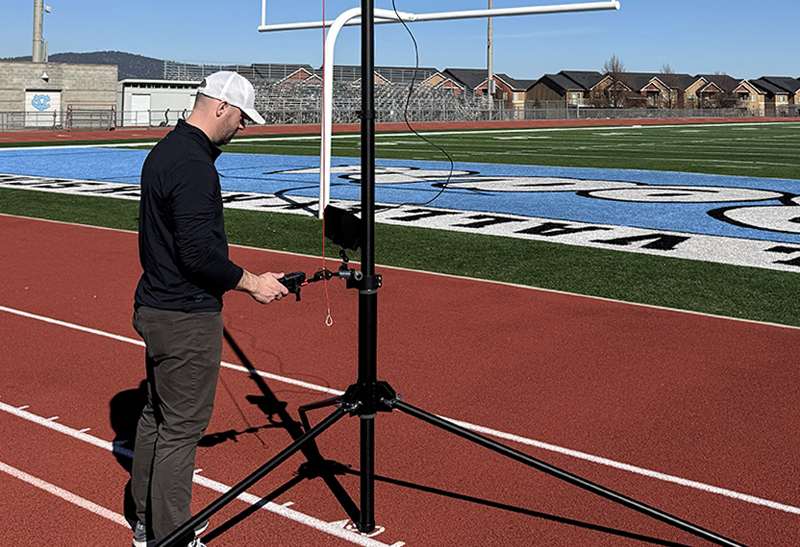
The catch is height. A low angle behind the offense is better than nothing, but it can quickly get cluttered by players, coaches, and movement near the line of scrimmage. Elevation solves that. A tall, stable endzone setup gives you cleaner sight lines and more consistent clips from rep to rep.
Sideline practice film is often the better complement for tempo, perimeter run game, special teams periods, and any segment where lateral spacing matters. It also helps when you need a broader view for staff review or athlete feedback. If your workflow supports both angles, your teaching gets sharper because coaches stop filling in missing information from memory.
This is where many programs overspend or buy the wrong type of system. A complicated setup may look impressive at first, but football staffs need repeatability more than novelty. In practice, simple manual controls and strong tripod engineering usually outperform motorized or overly electronic systems that add failure points.
A camera position that reaches above field traffic is important. So is a base that stays planted when conditions are not perfect. Wind, soft ground, and repeated adjustments expose weak support systems fast. If the pole flexes too much or the tripod shifts, your film quality drops and your operator starts babysitting the setup instead of filming practice.
Fast deployment matters just as much. Coaches do not want a 20-minute setup before a Tuesday practice. They want something that can be in place in minutes, moved when needed, and packed up without a long teardown. That is not a luxury. It is what keeps the filming process sustainable through an entire season.
The best camera system is the one your staff will actually use every day. That means your filming plan has to fit the people, software, and time you already have.
If your program uses Hudl Sideline, EDGE Replay, Game Strat, SkyCoach, or another review platform, compatibility should be part of the buying decision from the start. Clean video is only useful if it moves into your replay or upload process without extra work. Coaches should be able to capture, review, and teach from the same workflow they trust on game day.
Some schools have dedicated video staff. Many do not. In a lot of programs, practice filming falls to an assistant coach, coordinator, student manager, or technology staff member. That means the system cannot require a specialist just to get usable footage.
A practical setup has clear controls, minimal moving parts, and predictable operation. If a backup person can run it without calling for help every practice, your system is doing its job.
Not every team needs the exact same package. A smaller program may need one dependable elevated angle that can be set up quickly and moved between practice fields. A larger staff may want both an endzone tower and a press box or sideline tripod solution to cover more periods and support replay.
The trade-off is budget versus coverage. More angles can improve teaching, but only if your staff has the capacity to capture and manage them well. One reliable angle used every day is more valuable than two inconsistent angles that create extra work.
The first mistake is buying based on headline features instead of daily use. Coaches do not need a system that looks advanced on paper if it becomes a headache by week three.
The second mistake is underestimating the value of stability. Good optics matter, but shaky footage wastes the camera quality you paid for. Support hardware is not a minor accessory. It is the foundation of usable film.
The third mistake is treating practice and game filming as completely separate needs. In many programs, the smartest purchase is a coordinated setup that supports both environments with similar operation and compatible workflow. That reduces training time, simplifies storage and transport, and makes the equipment easier to trust.
The fourth mistake is assuming more automation always means better performance. In football operations, simpler systems often win because they are easier to deploy, easier to troubleshoot, and less likely to fail under pressure.
A football practice video guide is only helpful if it leads to better decisions. Before choosing equipment, think like an operator, not just a buyer.
Ask how high the camera needs to be to clear field traffic during your most congested periods. Ask how long setup really takes with one person. Ask whether the support system is built for regular transport, uneven ground, and windy conditions. Ask whether the footage works cleanly with your current review platform. And ask whether the system is simple enough that your process survives staff turnover.
Those questions usually lead programs toward reliable, football-specific solutions rather than generic camera stands or overbuilt systems with unnecessary complexity. This is one reason teams look at companies like Game Day Endzone. The focus is not on adding features for the sake of it. The focus is on stable, portable video solutions designed for football teams that need equipment to work every time.
Price matters, especially for school budgets, but value in practice filming is about more than the invoice. Lost reps on bad film, missed teaching moments, and staff time spent fighting equipment all carry a cost. So does replacing gear that was not built for repeated field use.
The better investment is equipment that gives you clean footage, quick setup, and dependable operation season after season. That kind of value shows up in more efficient practices, clearer corrections, and less stress for the people handling the video.
If you are building out your setup, keep your standards simple. Get the angle coaches need. Get enough height to make the film useful. Make sure the support system is stable. Keep operation straightforward. And choose a setup that fits the way your staff already works. When practice video feels easy to capture, it becomes something coaches rely on instead of something they work around.