
April 20, 2026
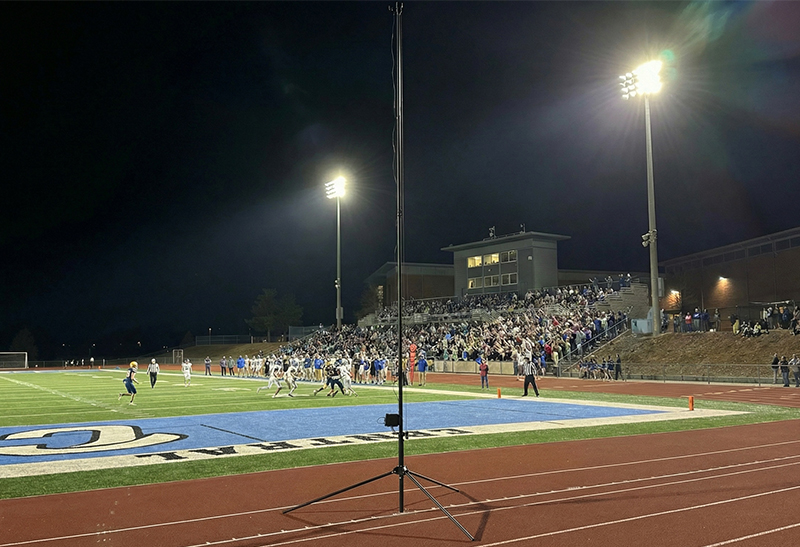
If your end zone copy is too flat, too crowded, or blocked by linemen at the snap, the first question to ask is simple: what height should endzone camera be? For most football programs, the best answer is around 25 feet for games. That height consistently gives coaches a clean look at spacing, blocking surfaces, backfield action, and route development without making the picture feel so high that it loses usable detail.
That does not mean every situation calls for the exact same setup. Practice filming, youth fields, restricted space behind the goal line, and staff size all affect what works best. But if you are buying or setting up a true game-day end zone system, 25 feet is the standard for a reason.
For game film, the sweet spot is typically 20 to 30 feet, with 25 feet landing right in the middle of the most useful range. It is high enough to see over the line and through traffic, but not so high that the image starts to feel detached from the play.
At lower heights, usually under 18 to 20 feet, the camera angle gets crowded fast. Offensive and defensive linemen block too much of the backfield. Pullers disappear behind bodies. Route stems and leverage are harder to judge. You may still get film, but it becomes less useful for coaches who need clean teaching tape.
At much higher heights, the trade-off changes. You gain wider field visibility, but individual detail can suffer depending on your camera and lens. Players can look smaller, and if the setup is not stable, wind movement becomes a bigger factor. Very tall systems can work, but only if the pole, tripod, optics, and operator setup are built for that kind of elevation.
That is why 25 feet has become a reliable standard. It gives a true top-down coaching angle without forcing programs into a more complicated system than they need.
Football coaches do not need a cinematic shot. They need a clear, dependable teaching angle that holds up every Friday night. A 25-foot end zone camera does that better than most alternatives because it balances three things that matter on film: visibility, stability, and practicality.
First, it improves line-of-scrimmage visibility. When the camera is elevated enough, you can actually see blocking structure develop instead of trying to guess what happened behind a wall of helmets. That matters on inside run, zone read, pass protection, blitz pickup, and goal line situations.
Second, it gives a more usable angle for spacing. Defensive fits, pursuit lanes, receiver splits, and route concepts all show up better when the camera is above the congestion. Coaches reviewing practice or game cutups want to see the whole picture develop, not just the point where the ball finished.
Third, 25 feet is still manageable in real football operations. It can be transported, set up quickly, and operated by staff without turning game-day filming into a technical project. That matters more than people admit. A taller system is not better if it takes too long to deploy or becomes unstable in weather.
There are cases where the best answer is not 25 feet. Practice is the most common one.
For many teams, a 10-foot practice pole is enough to capture inside run, team periods, and individual work. The reason is simple: practice film does not always need the same full-field, elevated coaching angle as Friday night game film. In practice, you are often focused on drill structure, assignment checks, tempo, and immediate correction. A lower setup can still be very effective, especially when portability and fast movement matter.
Field restrictions can also force a lower height. Some venues have tighter spaces behind the end zone, uneven ground, fencing, or safety limitations that make a full game-height setup harder to use. In those situations, the right move is usually to prioritize stability and a clean line of sight over squeezing out every extra foot.
Younger programs may also choose a lower setup at first if roster size, field dimensions, or budget make a simpler system the better fit. But if the goal is varsity-level game film for serious breakdown and replay workflows, lower heights usually become a limitation sooner rather than later.
The biggest problem is blocked vision at the snap. The line hides mesh points, run fits, and quarterback movement. Once that happens, your film loses coaching value even if the resolution is good.
A low camera angle also flattens the field. Distances between players are harder to judge. Route combinations look compressed. Defensive structure can be misleading because the camera is seeing through bodies instead of over them.
There is also an operational issue. When a camera sits lower, operators often try to compensate by zooming more aggressively. That usually creates its own problems. The tighter the zoom, the harder it is to keep the full play framed and the more obvious every small movement becomes.
Going too high creates a different set of trade-offs. The field can look clean, but players become smaller unless the optics are strong enough to hold detail. If the support system is not engineered for the extra height, stability becomes the next concern.
Wind is the biggest enemy of tall camera setups. A few extra feet may not sound like much on paper, but as height increases, small movements at the base can become noticeable shake at the camera head. That is why the pole, tripod, and control method matter just as much as the height number itself.
There is also a practical staffing issue. If a system is too complicated, too tall, or too dependent on electronics that can fail, coaches and video staff may avoid using it the right way. A system only helps if it is built to work every time.
When coaches ask what height should endzone camera be, they are really asking a bigger question: what setup will give us the most useful film with the least hassle? Height matters, but it works together with several other factors.
Optics matter because elevation alone does not fix poor image quality. A stable, elevated platform paired with quality zoom gives coaches the detail they need without sacrificing the wide coaching view.
Tripod engineering matters because tall systems magnify weakness. If the base is unstable, the footage will show it. That is one reason many football programs prefer manual control systems over motorized or wireless designs. Fewer failure points usually means better game-day reliability.
Operator simplicity matters too. The best end zone system is one that a manager, assistant, or video staffer can set up fast and run with confidence. If the system takes too long or feels fragile, it creates friction that shows up on game day.
For most high school and academy football programs, the most practical answer is a 25-foot end zone camera for games and a 10-foot pole for practice. That combination covers the full range of what staffs usually need without overcomplicating the operation.
A 25-foot game system gives the elevated angle coaches expect for breakdown, scouting, replay, and upload workflows. A 10-foot practice setup gives enough lift to improve visibility while staying portable and easy to reposition. Together, they create a complete filming approach instead of forcing one setup to do every job.
That is also why many programs look for systems that pair naturally with existing tools like Hudl Sideline, EDGE Replay, Game Strat, and SkyCoach. The camera height is not just about seeing the play. It is about capturing film in a way that fits how your staff actually uses video.
At Game Day Endzone, that is why the 25-foot platform remains the core game-day standard. It solves the real coaching problem without adding unnecessary complexity.
If you are choosing one number for game film, use 25 feet as your benchmark. If you are filming practice and need portability, 10 feet often gets the job done. If your venue or budget pushes you outside those numbers, stay focused on the outcome: clear, stable, coachable video that can be captured quickly and reliably.
The best camera height is the one that helps your staff see the truth of the play the first time they hit replay.