
June 12, 2026
Friday night gets hectic fast. If your filming setup takes 20 minutes to build, shakes in the wind, or drops out when you need a clean coaching angle, you already know the answer to what camera gear do football teams need: gear that works every time, sets up fast, and fits the way football programs actually operate.
For most programs, that does not mean buying the most complicated system on the market. It means building a reliable filming package around the angles coaches use, the platforms staff already rely on, and equipment that a manager, assistant, or video coordinator can run without fighting it all game.
A complete game-day setup usually starts with two angles: endzone and press box. Those are the views that matter most for play review, in-game correction, opponent breakdown, and postgame analysis. If a team only captures one angle, coaches usually feel that limitation right away. The sideline or press box view helps with formation, spacing, and perimeter structure. The endzone view shows blocking surfaces, run fits, leverage, and back-end structure in a way no sideline angle can.
That is why the core of a football video package should be a dedicated endzone camera system and a stable press box tripod setup. Everything else supports those two jobs.
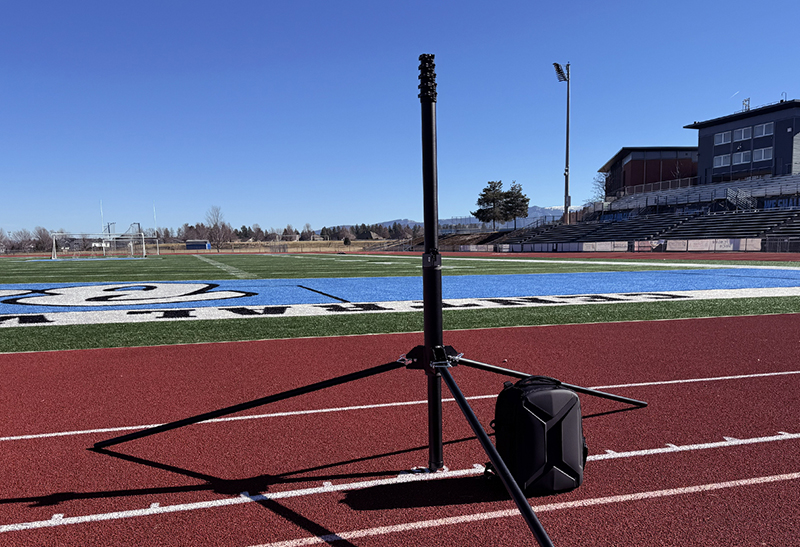
The endzone system needs height, stability, and simple operation. A 25-foot endzone pole is a practical standard because it gives teams the elevated angle they need without turning setup into a production. If that system is poorly engineered, though, height becomes a problem instead of an advantage. Football staffs need a pole and tripod base that stay steady, transport cleanly, and can be operated manually without depending on finicky powered components.
On the press box side, the priority is different. You do not need extreme height there. You need a tripod that stays planted, pans smoothly, and keeps the image stable through an entire game. Cheap tripods are one of the most common weak points in football video. The camera may be good, but if the platform flexes or vibrates, the footage suffers.
When coaches ask what camera gear do football teams need, the answer is not just cameras. It is a system. Each part affects the final result.
Before you think about lenses or resolution, think about where the camera sits. Football filming is unforgiving. Wind, uneven surfaces, tight press box space, and rushed setup all expose weak support equipment.
A strong endzone pole system matters more than most buyers realize. It needs to go up quickly, stay secure, and avoid excessive sway. Manual control is often the smarter choice than motorized or wireless control, especially for high school programs. Motorized systems can sound appealing on paper, but more electronics usually means more points of failure. On game day, reliability beats novelty.
A press box tripod should be built for field use, not adapted from general photography. Football operators need smooth movement and dependable lock-in, especially when tracking tempo offenses or sudden changes of possession.
Not every team needs a cinema-grade camera. Most football programs need a camera that delivers clear, coachable video, handles outdoor lighting well, and integrates into their existing upload or replay process.
A good football camera should offer clean zoom range, dependable focus, and image quality that holds up when coaches are reviewing splits, leverage, and technique. More expensive does not always mean more useful. If a camera creates file headaches, battery issues, or a complicated operator experience, it can slow the whole staff down.
The right choice usually depends on your workflow. If your team uses a sideline replay platform such as Hudl Sideline, EDGE Replay, Game Strat, or SkyCoach, camera compatibility and output options matter as much as picture quality. A camera that fits your existing system is worth more than one with better specs that creates extra work.
Premium optics make a real difference in football because coaches are not filming for highlight clips. They are filming for information. You need a clear view of assignment football, not a camera packed with consumer features nobody uses.
Strong optics help preserve detail from an elevated endzone angle and from the press box. That becomes even more important under stadium lights, in poor weather, or on fields where the operator is working from a long distance.
Plenty of teams spend their whole budget on the visible gear and then get tripped up by batteries, storage, cases, and transport. That is a mistake.
A football filming setup should include enough battery life for the full event with margin for delays, overtime, and cold weather performance loss. It should also include reliable media management and protective transport solutions. If your equipment takes damage moving from storage to the stadium, that is not a small issue. It is part of the system design.
Game-day gear gets most of the attention, but practice video matters just as much for development. The needs are a little different.
For practice, many programs benefit from a 10-foot filming pole that gives coaches a better teaching angle without the footprint of a full game-day endzone system. That extra height helps with inside run, team periods, and position work. It is easier to move, easier to deploy, and better suited for repeated daily use.
Practice equipment should be quick to set up and easy for staff to reposition. If the setup slows down the period plan, it will not get used consistently. That is why portable, simple systems usually outperform overbuilt ones in daily practice settings.
A lot of programs eventually move toward a bundled approach: one complete setup for game-day endzone, one for the press box, and one lighter solution for practice. That gives the staff consistent footage across the week without forcing one piece of equipment to do every job.
The biggest overbuy is usually complexity. Some staffs get pulled toward systems with extra motors, extra wireless controls, or features that sound advanced but add setup time and maintenance. If your crew changes from week to week, simpler is often better.
The biggest place teams should not cut corners is structural stability. If the pole, tripod, or mounting system is weak, the rest of the investment loses value. The second place not to cut corners is integration. Your gear should work with the platforms your coaches use now, not create a separate workflow that staff resent.
Durability is another place where cheaper equipment can get expensive fast. Football programs do not use camera gear in controlled studio conditions. It gets loaded in trailers, carried across tracks, used in heat and wind, and handled by multiple people. Gear built for that environment pays for itself.
A varsity program with a dedicated video role can handle a more complete setup than a smaller school where a coach is also managing substitutions, communication, and postgame upload. That is why the right package depends on staffing as much as budget.
If your program has limited personnel, prioritize speed and ease of use. A system that can be set up in less than five minutes and operated without technical troubleshooting is more valuable than one with a longer feature list. If your staff is larger and your workflow is more advanced, then you can think more about specialized camera choices or expanded capture options.
For most high school programs, the best answer is not a pile of disconnected gear. It is a purpose-built system where the support, camera position, portability, and workflow all make sense together. That is where specialized football equipment has a clear advantage over piecing together general-purpose video gear.
One reason many programs choose a focused provider such as Game Day Endzone is that the equipment is built around football use first - not adapted from another market and renamed for sports.
The best football video system is not the one with the longest spec sheet. It is the one coaches trust on third-and-goal in the fourth quarter, during a muddy practice on Tuesday, and when a staff member with limited training has to get the shot anyway.
If your current setup is shaky, slow, or inconsistent, that is usually not an operator problem. It is a system problem. Build around stable support, dependable cameras, practical height, clean optics, and easy compatibility with your replay and upload tools. When the gear is built to work every time, the video becomes an asset instead of a weekly headache.
Good football filming should feel routine. When it does, your staff can spend less time managing equipment and more time coaching what shows up on screen.