
May 7, 2026
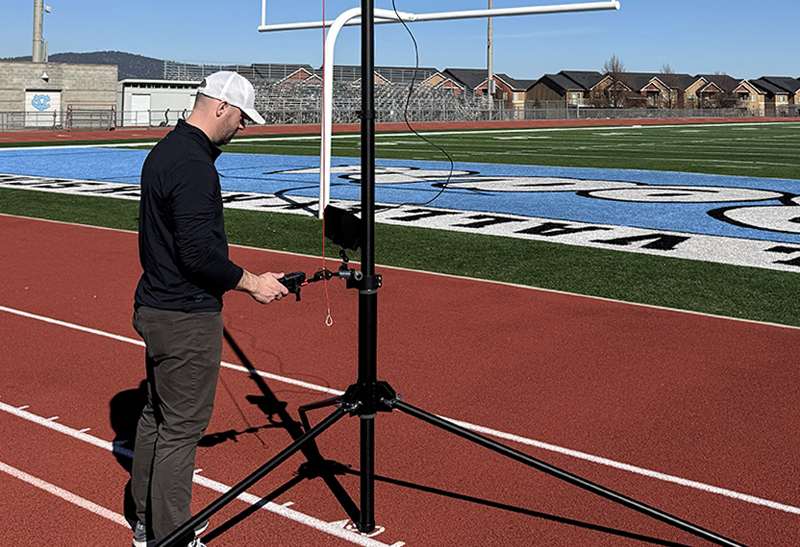
Friday night starts moving fast once the buses arrive. If your endzone camera setup is shaky, too low, or slow to deploy, you feel it immediately in the quality of your film and in the stress it adds to your staff. If you want to know how to film football endzone the right way, the answer is not just getting a camera in the air. It is building a repeatable setup that gives coaches clear, stable, coachable video every game and every practice.
Sideline video tells part of the story. Endzone video shows the spacing that wins and loses football. Coaches use it to evaluate line splits, run fits, leverage, pass protection, route structure, pursuit angles, and special teams lanes. When the angle is wrong, those details disappear.
That is why endzone filming should be treated like an operational tool, not an afterthought. The goal is not cinematic footage. The goal is usable football video that can be reviewed quickly, shared through your existing platform, and trusted by the staff on every snap.
The biggest mistake programs make is filming too low. A low angle compresses the field and hides spacing, especially in the box and in the secondary. You can still capture the play, but you lose coaching value.
A higher vantage point gives you cleaner separation between players and a better view of structure before and after the snap. For games, a tall dedicated endzone system is usually the best answer because it creates the angle coaches actually need. For practice, a shorter portable pole can still be effective when it is placed correctly and paired with stable support.
Height matters, but stability matters just as much. A tall system that sways in the wind or shifts during operation can ruin otherwise good footage. That is one reason many staffs prefer manual systems over motorized or wireless options. Fewer failure points usually means less game-day drama.
The best camera operators know that placement solves more problems than zoom ever will. Set the camera on the centerline of the field whenever possible. If you are off-center, your angles become harder to evaluate, especially for run game and pass distribution.
For game filming, position the endzone system deep enough behind the field so the operator can work comfortably and safely without interference. You want a clean line through the offense and defense, not a view blocked by fencing, netting, people walking, or equipment on the track.
The camera should be high enough to see all 22 players develop, but not so high that players become too small to evaluate. That balance depends on the field layout, the lens, and your platform’s video needs. In most cases, coaches prefer a wide, stable look that shows the full structure over an overly tight shot that loses edges and spacing.
A lot of bad endzone film comes from trying to force general-purpose equipment into a football-specific job. Standard tripods, light-duty poles, and improvised mounting solutions often look fine until wind picks up or the operator needs to adjust quickly between snaps.
Football programs need equipment built for repeated setup, travel, and pressure. That means a stable support system, reliable optics, quick deployment, and controls that do not depend on a fragile chain of batteries, wireless signals, or automated movement. If a system takes too long to assemble or requires a specialist to operate, it becomes a liability on game day.
This is where football-specific systems stand apart. A tall endzone camera built around stable tripod engineering and simple manual control is easier to trust because it is designed around what staff members actually deal with: weather, uneven surfaces, rushed setup windows, and operators who may also be handling other responsibilities. Game Day Endzone has built its systems around that reality.
Even with great equipment, operator habits still matter. The camera should be framed before the snap with enough width to keep the full formation, backfield action, and initial defensive structure in view. If the operator starts too tight, the play can outrun the frame before it develops.
After the snap, follow the play smoothly, not aggressively. Quick jerks and overcorrections make the footage harder to watch and harder to tag. Most football video is reviewed repeatedly, sometimes frame by frame. Smooth movement is not just about appearance. It directly affects coaching efficiency.
It also helps to hold the shot a beat after the whistle. Coaches often want to see late movement, finish, substitution behavior, or how players separate after the rep. Cutting too early throws away useful information.
One common mistake is assuming the same filming approach works equally well for games and practices. It does not. In games, you are usually trying to capture every snap consistently for upload, replay, and postgame review. That puts a premium on height, stability, and fast compatibility with your normal workflow.
In practice, the needs can shift. You may film team periods one day, inside run the next, and individual work after that. A shorter, more portable pole can make sense for flexibility, especially if the system moves from field to field. But the same principles still apply: centerline placement, adequate height, stable support, and framing that shows the structure coaches are trying to teach.
If your practice film is too narrow or too shaky, player development suffers because the coaching points are harder to confirm. The best practice setup is the one that gets used consistently because it is simple enough to deploy without slowing down the day.
For most programs, filming is only half the job. The other half is getting that video into the system your staff already uses. If your workflow depends on Hudl Sideline, EDGE Replay, Game Strat, SkyCoach, or another replay and exchange platform, your camera system has to support that process cleanly.
That means thinking beyond the camera itself. You need a setup that allows quick connection, dependable signal flow, and repeatable operation by staff members who may not be video specialists. A complicated rig can look impressive in a sales pitch and still create delays once the game starts.
The strongest setups are the ones coaches barely have to think about after they are deployed. They get a stable shot, the footage feeds where it needs to go, and the staff can focus on football.
Most endzone filming problems are predictable. The system is too light, so wind affects the image. The height is too low, so the interior action gets crowded. The operator zooms too tight, so the play runs out of frame. The setup takes too long, so the staff rushes through assembly and starts the game behind schedule.
There is also the reliability problem. Motorized features and wireless controls can sound appealing, but every added layer creates another possible failure point. Sometimes the smarter football decision is the simpler one: a durable manual system that is easy to transport, easy to raise, and built to work every time.
That trade-off matters more at the high school and academy level, where the camera operator may be a coach, student helper, or staff member managing multiple jobs. Simplicity is not a downgrade. In many programs, it is the reason the video gets captured correctly.
If you are evaluating how to film football endzone more effectively, look at the full operating picture. Ask how fast the system sets up, how stable it is at full height, how easy it is to transport, and how well it fits the video platform you already use. A system that performs well in one category but creates friction everywhere else is not really solving the problem.
Durability should be high on the list too. Football equipment gets loaded, unloaded, carried across fields, used in heat, cold, and wind, and expected to perform on schedule. If your endzone setup cannot handle that cycle, you are not buying value. You are buying replacement headaches.
The right system gives your staff confidence. It goes up quickly, stays stable, captures the angle coaches need, and supports a workflow that makes sense on game day and during the week.
Good endzone film is clear, centered, stable, and repeatable. It shows enough of the field to evaluate structure, and it does that without turning setup into a project. That is the standard football programs should expect.
If your current setup forces compromises every week, the problem is usually not your staff. It is the system. Better film starts with a better angle, but it lasts because the equipment and workflow are built for football from the start.
The best endzone setup is the one your coaches trust without hesitation when the game gets busy.