
May 21, 2026
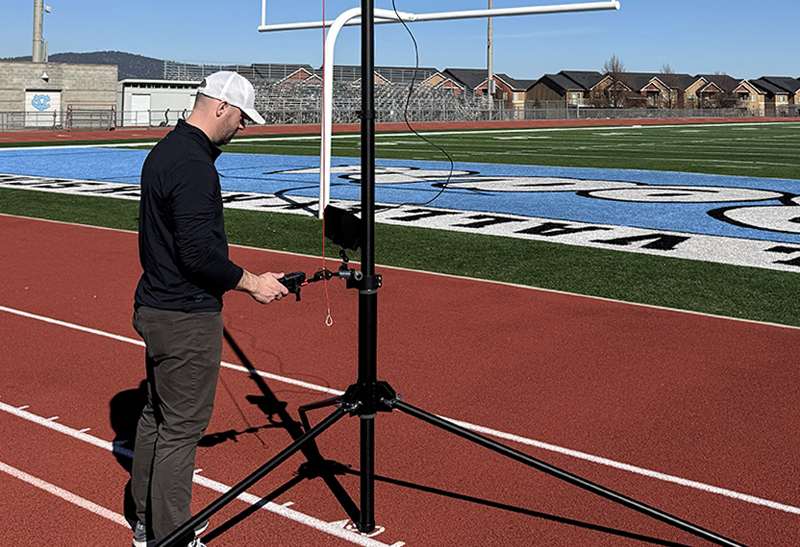
Friday night gets loud fast. If your video system is shaky, too low, or takes 20 minutes to build while your staff is handling headsets and warmups, it is already costing you. The right camera setup for football coaches is not about adding more gear. It is about getting clean, usable film every time, with a setup your staff can deploy quickly and trust for games and practice.
For most football programs, that means thinking less like a videographer and more like a coach. You need wide, stable angles that show spacing, leverage, and assignment football. You need a system that works with your replay and upload process. And you need hardware that does not become a weekly problem.
A football filming system has one job: capture coachable video under real field conditions. That sounds obvious, but many teams still buy based on camera specs alone and ignore the setup around it. In football, the support system matters just as much as the camera body.
If the platform sways in the wind, the footage is harder to grade. If the angle is too low, you lose formation structure and route spacing. If the operator needs an app, a motorized head, a battery pack, and a wireless connection just to move the camera, you have added failure points to the one part of the workflow that has to work every time.
That is why strong football setups usually prioritize three things: elevation, stability, and simplicity. Image quality matters, of course, but most coaching staffs benefit more from dependable, well-framed video than from chasing cinema-level specs they do not need.
For game film, most programs need two primary views: endzone and sideline. If you can only invest in one first, the better choice depends on how your staff uses film, but endzone footage often delivers the clearest coaching value because it shows box structure, run fits, blocking surfaces, and route distribution in a way sideline video cannot.
A true elevated endzone angle changes what you can teach from the film. At ground level or from a low tripod behind the goal line, players overlap, interior play gets crowded, and it becomes harder to evaluate spacing. A higher platform gives coaches cleaner sight lines into the core of the play.
That is why many staffs prefer a 25-foot endzone camera system rather than trying to improvise with a standard tripod or temporary lift. The higher angle is not just about seeing more field. It is about seeing the right details clearly enough to coach from them.
There is a trade-off, though. Taller systems need to be engineered for stability and fast deployment. Height without a solid base creates movement, and movement ruins otherwise good footage. If your endzone setup is tall but shaky, you have not solved the problem.
On the sideline view, most teams film from a press box, roof, or elevated home side position. Here, smooth panning and a secure tripod matter. A lightweight consumer tripod may seem fine in a parking lot test, but under real game conditions it often shows its limits. Wind, repeated panning, and uneven surfaces expose weak legs and unstable heads quickly.
A press box tripod setup should feel boring in the best possible way. It should lock in, track the play cleanly, and stay out of the operator's way. Coaches and video staff do not need a fancy rig. They need one that produces consistent footage from kickoff to the last snap.
Practice is where many programs overbuild. They try to recreate a game-day system for every drill period, and that usually creates more hassle than value. A good practice setup should be portable, fast, and useful across multiple fields or segments.
A 10-foot practice pole is often the right answer because it gives enough elevation to clean up the teaching angle without turning setup into a production. For inside run, team periods, and individual segments, that extra height can make a major difference in how fast coaches can review and correct technique.
The key is mobility. If your practice camera setup takes too long to move, it will stay in one place and become less useful. The best practice systems are the ones your staff will actually use every day.
Many buying decisions get framed around equipment features when the real issue is workflow. Before choosing a system, coaches should ask a simpler question: how does this footage get from the field to the people who need it?
If your staff uses Hudl Sideline, EDGE Replay, Game Strat, or SkyCoach, compatibility is not a side detail. It is central to the purchase. A setup that produces good video but creates friction in replay, review, or upload is not helping your program. Football staffs need the camera platform and the video workflow to fit together cleanly.
This is where simpler manual systems often outperform more complex motorized setups. Motorized heads and wireless controls can sound attractive, but they also introduce batteries, connectivity issues, pairing problems, and extra troubleshooting on game day. For some programs, those systems can make sense. For many high school teams, they add complexity without improving the coaching result.
A manual control system is easier to train, easier to maintain, and easier to trust. That matters when a volunteer, student manager, or young staff member is helping run the setup.
The biggest mistake is treating football filming like general event video. Football has very specific needs. You are not trying to produce dramatic highlight footage. You are trying to capture information.
One common issue is buying a good camera and putting it on a weak support. Another is choosing a system that looks advanced but takes too long to set up. Teams also underestimate portability. A heavy or awkward system may still perform well once assembled, but if it is difficult to transport, store, or deploy, it will create friction all season.
There is also a budget mistake coaches run into. They compare the upfront price of a purpose-built football system against a pieced-together consumer setup and assume the cheaper route saves money. Sometimes it does. Often it does not. When a cheaper setup needs constant replacement, misses film, or wastes staff time, the math changes quickly.
Start with the field use case. If your biggest need is game analysis, prioritize endzone height and sideline stability. If your staff reviews practice heavily, make sure your practice solution is fast to move and easy to run.
Then evaluate durability. Football equipment gets hauled, stored, loaded, unloaded, and used in weather that is less than ideal. Build quality is not a luxury in this category. It is part of performance.
You should also look closely at setup time. If a system can be deployed in less than five minutes, that is a real operational advantage. It reduces stress before kickoff and increases the chance that your team will use it consistently at practice.
Finally, think about who will operate it. The best system for your program is not the one with the longest feature list. It is the one your staff can run confidently without extra troubleshooting.
For most programs, a complete setup starts with an elevated endzone system, a press box tripod for the sideline angle, and a portable practice solution. That combination covers the core needs of games, replay, scouting, and daily teaching without overcomplicating the operation.
Bundled systems often make sense because they eliminate guesswork. Instead of matching tripods, mounts, poles, and accessories from different sources, coaches get a setup designed to work together. That usually improves reliability and shortens deployment time. For programs replacing outdated video gear, it is often the fastest path to a clean reset.
Game Day Endzone has built its systems around that reality - football staffs need dependable video hardware that is stable, portable, and easy to operate under pressure.
The right setup should feel simple once it is in your routine. Your staff arrives, sets it up, captures clear film, and moves on to coaching. That is the standard worth buying for, because the best video system is the one your program never has to worry about when the game starts.