
April 6, 2026
Friday night is not the time to find out your filming system is too shaky, too slow to set up, or too complicated for your staff to manage. A portable endzone camera tower has one job - give your program clean, elevated video without creating more work on game day. If it takes too long to assemble, drifts in the wind, or depends on finicky controls, it stops being an asset and starts becoming a problem.
For most football programs, the right tower is not the one with the longest feature sheet. It is the one that gets on the field fast, stays stable through four quarters, and delivers video your coaches can actually use for replay, grading, and scouting. That sounds simple, but there are real differences between systems, and those differences show up quickly once the season starts.
A good tower solves three operational issues at once. First, it gives you the height needed to capture the full structure of the play. Second, it keeps the image stable enough for coaches to evaluate spacing, leverage, and execution. Third, it makes setup realistic for the staff you already have.
That last point matters more than many buyers expect. Plenty of systems look good in product photos, but football programs do not operate in a showroom. They operate with limited time, changing weather, and game-day crews who may already be handling headsets, tablets, replay, and sideline communication. If your tower needs constant adjustment or a highly technical operator, it creates friction every week.
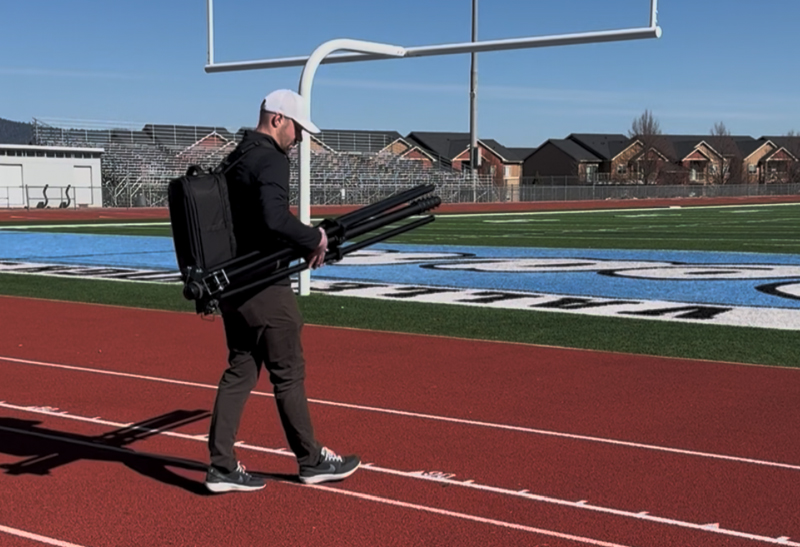
Portability is not just about whether a system folds up and fits in a vehicle. Real portability means one person or a small crew can transport it, deploy it quickly, and pack it down without turning setup into a 30-minute project. That is the standard most schools should use.
If the image shakes, the rest of the spec sheet does not matter much. Coaches need usable film, not just elevated film. A tower can be tall, lightweight, and easy to move, but if it sacrifices stability to get there, the trade-off is not worth it.
This is where engineering matters. Tripod design, base footprint, material strength, and center of gravity all affect how the system performs in live conditions. Wind, uneven ground, sideline traffic, and repeated use over a season all expose weak points. A tower that feels acceptable in calm conditions can become frustrating fast once weather or field surfaces change.
There is always some tension between portability and rigidity. Ultralight systems are easier to carry, but they often give up the planted feel programs need for consistent filming. Heavier systems may be more stable, but if they are hard to transport or cumbersome to raise, they can create another problem. The best towers balance both instead of forcing a choice between them.
Many football staffs want the highest tower they can get, and that instinct makes sense. More elevation generally gives you better angles for seeing formations, run fits, route spacing, and coverage structure. But height only helps if the footage stays clear and stable enough to review.
For game film, a 25-foot system is often the sweet spot because it gives a true endzone look without pushing setup into something overly complicated. Lower systems can still be useful, especially for practice or smaller-field applications, but they do not always provide the same coaching value on wide game shots. A practice pole has a place. A full game-day tower has a different job.
The better question is not just how tall the tower is. Ask whether that height is practical every week. Can your staff raise it confidently? Can it hold position through a full game? Can it produce a clean shot with the camera and lens package you actually use? That is the kind of height that matters.
Coaches and athletic departments often underestimate the value of quick deployment until they have lived with a slow system. A portable endzone camera tower should not require a complicated sequence, special troubleshooting, or constant fine-tuning before kickoff.
Fast setup is not only about convenience. It is about consistency. When a system can be deployed in just a few minutes, your staff is more likely to use it properly every time. When setup is tedious, corners get cut. That can affect camera angle, stability, and even whether the system makes it onto the field early enough for warmups or pregame testing.
Simple systems usually outperform complicated ones over the course of a season. Manual controls, straightforward locking points, and dependable mechanical design tend to be easier to trust than solutions built around extra layers of electronics or automation. Motorized features can sound attractive, but they also add more failure points. If something stops working on a Thursday walkthrough or during a first-quarter adjustment, that convenience disappears quickly.
Programs often focus on camera specs first, but tower quality has a direct effect on what the camera can deliver. Even a strong camera and lens package will struggle if the support system moves too much, wobbles during operation, or lacks smooth manual control.
That is especially true when footage is feeding into replay and coaching workflows. If your staff uses platforms like Hudl Sideline, EDGE Replay, Game Strat, or SkyCoach, your video needs to be reliably captured and easy to work with. Soft, shaky, or inconsistent footage slows down the process and reduces the value of the system.
A good filming setup is an ecosystem. The tower, tripod engineering, camera position, optics, and operator workflow all affect the final result. Buying the wrong tower can limit the performance of everything attached to it.
This question should guide every buying decision. Some programs have a dedicated video coordinator. Many do not. In plenty of cases, the person operating the system might be a staff assistant, a volunteer, or someone helping across multiple roles.
That means the best portable endzone camera tower is often the one that is easiest to run correctly under pressure. Clear controls, stable movement, and predictable setup matter more than flashy features. If a system demands constant technical attention, it becomes less usable for real football operations.
Reliability is also a staffing issue. When coaches trust the equipment, they can hand off operation with confidence. When the gear is temperamental, it pulls attention away from coaching and game management.
Price always matters, especially for high school programs and athletic departments balancing multiple needs. But the cheapest option is rarely the best value if it has to be replaced early, repaired often, or worked around every week.
A better buying approach is to think in seasons. How will the system hold up after repeated transport, weather exposure, field setup, teardown, and storage? Will it still feel dependable in year three, or will it already be showing stress in the parts that matter most?
The right system usually costs less over time because it stays in service, protects your filming workflow, and avoids the hidden costs of missed footage or staff frustration. That is where durable construction and a well-designed manual system earn their value.
When evaluating options, focus on field performance instead of marketing language. Ask how quickly the tower sets up, how stable it is at full height, and how it travels from field to field. Ask what kind of camera load it is built to handle and how it integrates with the replay platform your staff already uses.
It is also worth asking what support looks like after the purchase. Football programs do not need generic equipment vendors. They need a partner that understands the timing, pressure, and workflow of game day. That is one reason specialized providers such as Game Day Endzone stand out - the equipment is built around how football teams actually film, not around a general-purpose hardware concept.
The best buying decisions are usually the least glamorous ones. They come from choosing equipment that works every time, not equipment that sounds impressive in a sales pitch.
A portable endzone camera tower should make your operation calmer, faster, and more dependable. If it does that, your coaches will notice the difference before the first quarter is over.