
April 28, 2026
Miss one inside run period because the camera shook, cut out, or missed the mesh point, and the whole practice film loses value fast. If you're figuring out how to record football practice, the goal is not just getting video. It's getting clean, usable footage your staff can coach from the same day.
Practice filming has a different job than game filming. In games, you're capturing a complete record of the action. In practice, you're trying to coach details - alignment, tempo, footwork, leverage, pursuit angles, and execution from rep to rep. That means your setup has to be fast, stable, and simple enough that it works every day, not just when your most experienced video person is available.
The biggest mistake programs make is treating practice filming like an afterthought. They use whatever camera is available, put it on an unstable tripod, and hope the angle is good enough. Usually it isn't. Good practice film starts with deciding what your staff actually needs to see.
For team periods, the end zone angle is often the most valuable because it shows spacing, fits, blocking surfaces, and pursuit. If you're filming inside run, team offense, team defense, or special teams structure, that angle gives coordinators a much clearer coaching view than a low sideline shot. The press box or sideline angle still matters, especially for route depth, perimeter play, and overall structure, but if you only have one setup, most staffs get more coaching value from a clean elevated end zone view.
You also need to decide whether you're filming every period or only the competitive ones. Some programs want individual and group periods on film for player development. Others only need inside run, skelly, team, and special teams. There isn't one right answer. It depends on staff workflow, storage capacity, and how quickly coaches can review clips. The key is consistency. If your staff expects film from a period, the system has to be ready every day.
If the camera moves, shakes in the wind, or drifts during a rep, your coaches spend more time fighting the video than learning from it. Stability matters more than most teams realize.
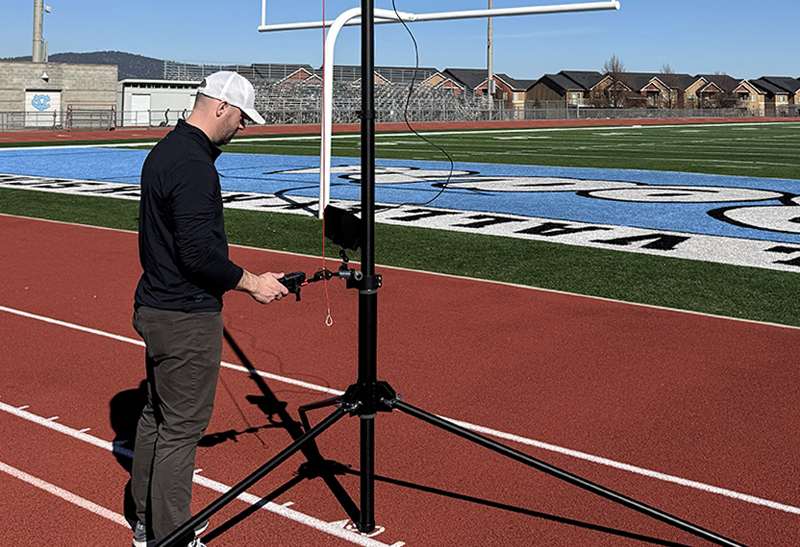
For end zone filming, elevation is what separates useful film from film that only tells part of the story. A higher angle lets you see run lanes open, defensive fits develop, and spacing hold or break down. A low camera behind the offense can work in a pinch, but it often hides the exact details coaches are trying to grade. A dedicated end zone camera system or a practice pole built for football use gives you a better line of sight and a more repeatable setup.
For sideline or press box filming, the same rule applies. Use equipment designed to stay planted and level, not a lightweight consumer tripod that flexes every time someone bumps it. Practice environments are busy. Managers, players, and staff move quickly. Your filming equipment has to tolerate real football traffic.
This is one reason many programs avoid overly complicated motorized systems for daily practice use. On paper, remote movement sounds convenient. In real football operations, more moving parts can mean more failure points, more setup friction, and more troubleshooting when you don't have time for any of it. A manual system with solid engineering is often the better choice because it is predictable and built to work every time.
A lot of staffs chase camera specs when the bigger issue is framing. You can have a good camera and still get bad practice film if the shot is too tight, too low, or constantly changing.
The frame should show the full structure of the play without forcing the operator to guess where the action is going. For team periods, keep enough width to see formation, perimeter support, and secondary structure, while staying tight enough that coaches can still evaluate detail. If the operator is zooming aggressively every rep, the footage usually becomes less consistent and harder to review.
For practice, consistency beats creativity. Use the same angle, similar zoom, and similar operator habits every day. That way your coordinators and position coaches know what they are looking at as soon as the clip starts.
If you're filming individual drills, it may make sense to lower the setup or move closer so the coach can see footwork and hand placement. That's where it depends on the period. The best practice filming plans use one standard setup for team periods and a flexible approach for drills and group work.
The best filming system is the one your team can deploy quickly without turning practice into a production. Setup time matters because football staffs already have enough to manage before practice starts.
A good process is straightforward. Get the camera platform in position, level it, mount the camera securely, confirm framing, check battery or power, and verify your upload or replay workflow before the first period begins. If this takes 20 minutes and requires a highly technical operator, the process will break down sooner or later.
Reliable practice filming should feel routine. Your student manager, video coordinator, or assistant should be able to set it up with confidence. That's where purpose-built football equipment separates itself from generic gear. It removes steps, reduces adjustment issues, and gives you a repeatable starting point.
Programs that want both end zone and sideline film should think in terms of a complete workflow, not isolated pieces of equipment. A stable end zone system paired with a dependable press box or sideline setup gives the staff more complete teaching film and creates fewer compromises when personnel changes week to week.
Raw footage by itself doesn't help much. The value comes from how quickly your staff can use it.
If your program uses platforms like Hudl Sideline, EDGE Replay, Game Strat, or SkyCoach, your filming setup should support that workflow cleanly. Coaches don't want film trapped on one device or delayed because the capture process was too clunky. They want the rep available when it matters.
That does not mean every practice needs a complicated live production environment. It means your system should produce a dependable video feed and fit into the tools your staff already trusts. Compatibility, stable output, and simple operation matter more than bells and whistles.
It also helps to assign responsibility clearly. One person owns the end zone setup. One person confirms the camera is rolling. One person verifies clips are available after practice or during key periods. When everyone assumes someone else handled it, that's when film gets missed.
Most bad practice video comes from a few repeatable issues. The first is using unstable equipment that was never designed for football environments. The second is filming from too low an angle, especially from the end zone. The third is making the setup too complicated for daily use.
Another common problem is poor camera placement relative to the drill. If the camera is off-center behind the offense or too far to one side, the coaching picture gets distorted. Small placement errors can make run fits, blocking angles, and pursuit look different than they really are.
Weather and field conditions matter too. Wind exposes weak tripod systems quickly. Uneven ground exposes poor leveling. Busy practice fields expose gear that is hard to move or too easy to knock over. Durability is not a luxury in this setting. It's part of video quality.
Finally, some teams film everything but review almost nothing because the footage is inconsistent or hard to access. If your coaches stop trusting the film, the whole process loses value. Better to capture fewer periods well than record every minute poorly.
Football practice is repetitive by design. Your filming system should handle that repetition without becoming another problem to solve. That usually means stable support, quality optics, simple controls, and a setup process that does not depend on ideal conditions.
For many programs, the smart answer is a dedicated end zone solution for practice and games, plus a sideline or press box setup that matches it operationally. That gives coaches a professional-level view without adding unnecessary complexity. Companies like Game Day Endzone have built systems around that exact need - portable football filming equipment that sets up quickly, holds steady, and works with the replay platforms teams already use.
If you're buying for a high school or academy program, value matters, but cheap and cost-effective are not the same thing. A lower-priced system that fails under pressure usually costs more in lost reps, staff frustration, and replacement purchases. The better investment is equipment your staff can trust every day.
When you're deciding how to record football practice, think less about flashy features and more about whether the film will be clear, stable, and ready when coaches need it. That's what turns practice video from another task into a real coaching tool.